
The Billion-Dollar Condo Bailout: How Carney and Eby Socialize Losses While Privatizing Profits
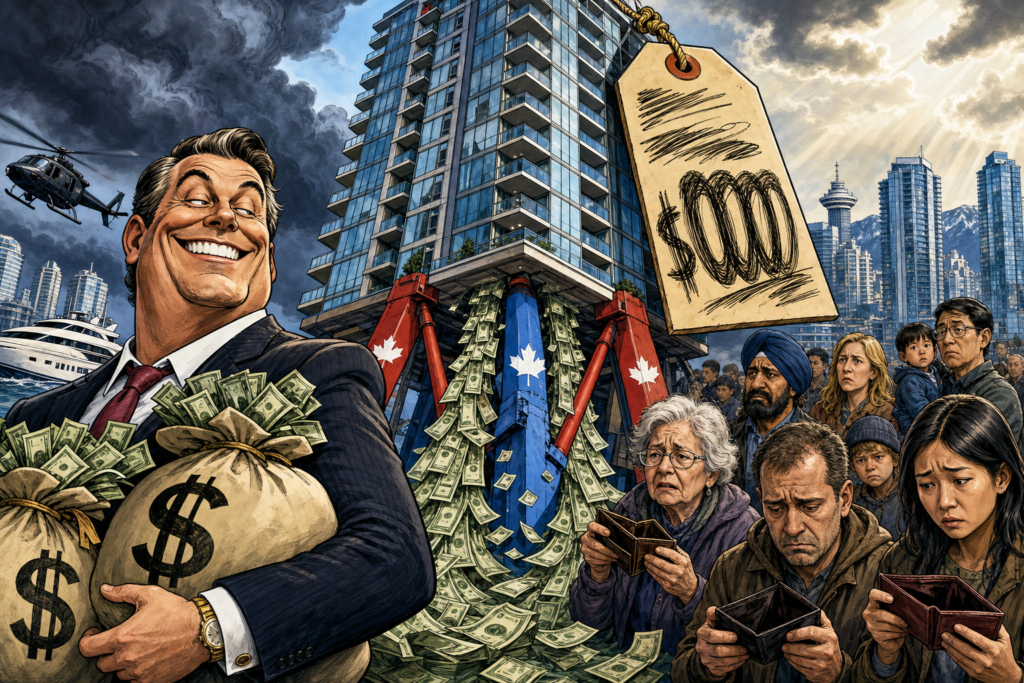
The Billion-Dollar Condo Bailout: How Carney and Eby Socialize Losses While Privatizing Profits
In a move that has drawn sharp criticism from economists, opposition politicians, and ordinary Canadians alike, Prime Minister Mark Carney’s federal government has announced a sweeping partnership with British Columbia Premier David Eby to purchase thousands of unsold condominiums in Vancouver. The deal, struck after Parliament has risen and deep into the summer recess — a timing critics call deliberately calculated to minimize public scrutiny — commits billions of taxpayer dollars to rescue developers from the consequences of their own bad bets.
The question is not whether governments have a role in housing. The question, as always, is the price — both financial and philosophical. And on that score, the evidence so far points to a policy that is not merely flawed but fundamentally unjust: a massive transfer of wealth from ordinary Canadians to wealthy developers, disguised as an affordable housing initiative.
The Deal: What We Know (And What We Don’t)
The arrangement announced by Carney and Eby is remarkably vague on details. The two governments have pledged a combined federal-provincial commitment that could add up to billions of dollars — all borrowed money, meaning it will be repaid by taxpayers over decades. The target: potentially thousands of unsold condominium units across the Greater Vancouver area.
Here is what we do know. Developers are reportedly refusing to clear the market at current prices, holding out at roughly $1,000 per square foot or more — a figure that bears little resemblance to today’s market reality, where prices in many cases have fallen by hundreds of dollars per square foot from their peaks. The government, instead of letting market forces work, appears willing to pay yesterday’s inflated prices to keep developers whole.
The partnership announced between the two governments includes spending more than $5 billion on B.C. infrastructure, $3.2 billion to lower development charges for multi-unit housing — reducing costs by up to 50 percent in communities that are deemed a priority — and $284 million to reduce barriers for new construction. On paper, these supporting measures sound reasonable. But layered on top of the condo bailout itself, they reveal a coherent strategy: use taxpayer money to subsidize development at every stage, from land assembly through to the point where unsold inventory must be absorbed by government balance sheets.
After 72 hours of intense online backlash, the federal government has said nothing. No clarification. No adjustment. As the old saying goes, silence speaks volumes.
“Dog Crates in the Sky”
Consider what these unsold units actually are. The majority, according to mortgage broker Ron Butler of Butler Mortgage, are what he has bluntly described as “dog crate” condos — tiny studio apartments in the sky, built and priced on a square-foot basis designed to optimize returns for speculative investors rather than provide livable homes for actual residents.
The speculative boom that produced these units made developers hundreds of millions of dollars. A few became billionaires. Those investments have now turned out to be bad — not because of some external market failure, but because the fundamental economics simply don’t work. Interest rates rose sharply from their pandemic-era lows. Market demand for condos in Toronto and Vancouver fell precipitously. Prices declined by as much as 20 percent in some markets. Buyers walked away from deposits they had placed years earlier, leaving developers holding units they assumed they had already sold.
In Metro Vancouver alone, court-ordered sales — a proxy for financial distress in the housing market — increased from just 28 listings in October 2023 to 66 in October 2024 and then to 119 in October 2025. Broader data from Equifax shows that mortgage delinquencies across British Columbia are rising sharply, with missed payments increasing by roughly 36 percent year-over-year in high-cost markets. These numbers tell a clear story: the housing market is under significant stress, and the government’s response has been to bail out the developers at the center of that stress rather than address its root causes.
This is not a crisis requiring government intervention. This is the market working exactly as it should.
The Profit and Loss System: The Foundation of Capitalism
This is the heart of the matter. Capitalism runs on a profit and loss system. As economist Milton Friedman famously argued, profits incentivize risk-taking while losses punish excessive risk — and that discipline is essential for a healthy economy.
Developers have lobbied both governments intensively, warning that selling at today’s market price could push some out of business. But that is precisely the discipline a correction is supposed to impose. If governments step in to spare firms that made wrong bets, they distort the market and prevent the correction Canada desperately needs — a correction not only in price but in the kind of homes we build.
The logic is hard to argue with. When developers gambled on luxury condos priced beyond what local incomes could support, they took a calculated risk. When that gamble failed, the natural response is for them to absorb those losses — just as any responsible business would. Instead, Carney and Eby are choosing to socialize those losses across the entire taxpayer base.
This is, in essence, the worst of both worlds: the most extreme form of capitalism when things go right — privatizing all profits for developers and investors — combined with the most extreme form of socialism when things go wrong — socializing all losses for taxpayers. It is a system that rewards failure and punishes responsibility.
The Hidden Cost: Denying Homeownership to Canadians
There is a more insidious cost still that rarely gets discussed in the policy debate. At a clearing price — one that reflects actual market conditions, not inflated developer expectations — many of these units would find buyers. Canadians who want to own a home but refuse to pay $1,000 per square foot for units that simply are not worth it at those prices.
This policy denies them that option entirely. Instead of letting the market find its natural price floor and allowing willing buyers to purchase at fair value, the government steps in as buyer of last resort. Would-be homeowners are offered only one path forward: government-subsidized and entirely dependent tenancy.
In a country where principal residences enjoy a 100 percent capital gains exemption — arguably the most valuable tax shelter available to ordinary Canadians, the golden goose that lays the golden egg for middle-class retirement security — this distinction between ownership and tenancy is enormous. Homeownership builds generational wealth; renting does not. It is the difference between building secure wealth for retirement and remaining perpetually dependent on government programs.
The government’s defense — that these units will be converted into affordable housing — rings hollow for several reasons. First, the claim that the government cannot build cheaply does not rescue this scheme. If Carney and Eby are quietly conceding that the public system cannot build affordable housing affordably, that should raise serious doubts about their competence to manage this entire operation efficiently. Purchasing overpriced luxury condos and converting them is unlikely to be cheaper than new construction.
Second, many of these unsold units are tiny investor-focused layouts — single studios and one-bedrooms that simply do not work as family housing. Converting them into genuine affordable family housing would require expensive renovations that further inflate the already questionable cost-effectiveness of this program.
Third, and perhaps most importantly, if markets were left to correct themselves naturally, the demand for social housing might be far smaller than assumed. By propping up prices artificially and keeping developers in business regardless of performance, this policy ensures that the speculative development cycle will repeat itself. There is no incentive for developers to build what people actually need when the government guarantees they will never lose money.
The Betrayal of Responsible Buyers
Spare a thought for the buyers who honoured their contracts. These are Canadians who cobbled together every cent they had to close on their purchases — the only alternative being walking away from their deposits and facing costly legal proceedings. They met yesterday’s price. They took the risk. They did what was asked of them.
And now? Now they stand to watch socialized housing arrive in the unit next door. Their asset values fall as their luxury building turns into government-subsidized tenancy, with everything that implies for property values, building quality, and neighborhood character. They never factored this into their investment plan, yet they are the ones bearing the hidden cost of this bailout.
This is not just unfair to these individual buyers. It undermines confidence in the entire housing market. When people see that responsible behavior is punished while speculative excess is rewarded, they lose faith in the system. And that erosion of trust has long-term consequences that extend far beyond any single development or neighborhood.
A Pattern, Not an Anomaly
This bailout does not exist in isolation. It fits a broader pattern of federal and provincial governments increasingly intervening to prop up real estate markets that were never sustainable in the first place. The $3.2 billion promised to lower development charges for multi-unit housing, the $5 billion in B.C. infrastructure commitments, the $284 million to reduce barriers for new construction — all of it points to the same conclusion: governments are now deeply committed to keeping real estate prices artificially high, regardless of market fundamentals.
We have seen this movie before. During the 2008 global financial crisis, governments around the world bailed out banks and financial institutions deemed “too big to fail.” The rationale was similar: let them collapse and the entire economy goes down with them. Developers are making the same argument now — that if they go under, tradespeople lose jobs and local economies suffer. But the comparison is flawed. Banks are systemic; individual developers, however large, are not.
The Political Calculus
Timing matters. By announcing this deal after Parliament has risen and during the summer lull, Carney’s government clearly calculated that public attention would be minimal. Fewer journalists covering politics. Opposition parties on recess. Ordinary Canadians focused on vacations rather than federal spending commitments worth billions of dollars.
Pierre Poilievre, Conservative leader, was quick to call out the scheme at Vancouver International Airport on Sunday. “The condo goes from expensive to less expensive,” he said. “Who’s going to pay the difference? Well, Mark Carney wants you, the taxpayer, struggling with mortgage bills and gas prices, to pay those losses instead of the developers.”
That framing captures exactly why this policy is so politically toxic. Canadians facing their own mortgage stress, watching inflation erode purchasing power, are being asked to foot the bill for developers’ failed investments. The political math is simple: developers have money and influence; ordinary homeowners do not. Governments will always respond to the former first.
The federal government’s justification centers on comments made by Carney at the announcement, where he stated that “with higher interest rates, weaker investment demands, developers are stuck… they don’t want to sell at a loss… they cannot afford to hold those empty units indefinitely.” But as critics point out, this is the exact same situation affecting many regular homeowners who also cannot afford to sell at a loss and cannot hold onto their homes indefinitely. For regular Canadians, there is no taxpayer bailout. There is only foreclosure and hardship.
The Road Ahead
No further details have been released by either the federal Liberal or provincial NDP government on how this costly program would actually work. Canadians are being told to wait until the fall to see the actual framework — another delay tactic designed to let this story fade from headlines before the specifics emerge. This deliberate obfuscation is itself a red flag. A good policy does not need to be hidden.
The consequences of this policy extend far beyond Vancouver. If successful, it creates a dangerous precedent: developers anywhere in Canada can now anticipate government bailouts when their speculative projects fail. The market discipline that prevents overbuilding collapses entirely when losses are socialized and profits remain privatized. We could see a repeat of the same speculative boom — this time with even less caution from developers who know the government has their back.
The federal partnership with B.C. represents more than a bad deal for one province. It signals a fundamental shift in how Canada approaches housing policy — away from market-based solutions and toward government-managed outcomes that benefit politically connected developers at the expense of ordinary citizens. Housing was supposed to be about shelter, not speculation. This bailout makes that vision even further away from reach.
The billion-dollar-plus condo bailout represents everything wrong with contemporary Canadian housing policy. It rewards speculation, punishes responsibility, distorts markets, and transfers wealth from ordinary citizens to the wealthy. It is time for Canadians to ask: who exactly benefits from this deal? And more importantly, who pays the price?
The answer, unfortunately, is already clear. The developers profit. The politicians claim credit. And the taxpayers — you and me — foot the bill.